
Loading…
Sky Trace · An Astronomical Record of Your Birth Moment
The sky of the moment you were born, rebuilt from astronomical data — date, exact time and place — and engraved on a personal brass card. Computed, not interpreted.
Hesabın doğrulanıyor…
REAL COMPUTATION EXAMPLE · APPROVED MASTER FIXTURE
This example comes from the approved 1990 Istanbul card master fixture in the repository. Date, time and place are the same computation inputs; the astronomy values are the engine output stored in that fixture.
Personal Brass Sky Card
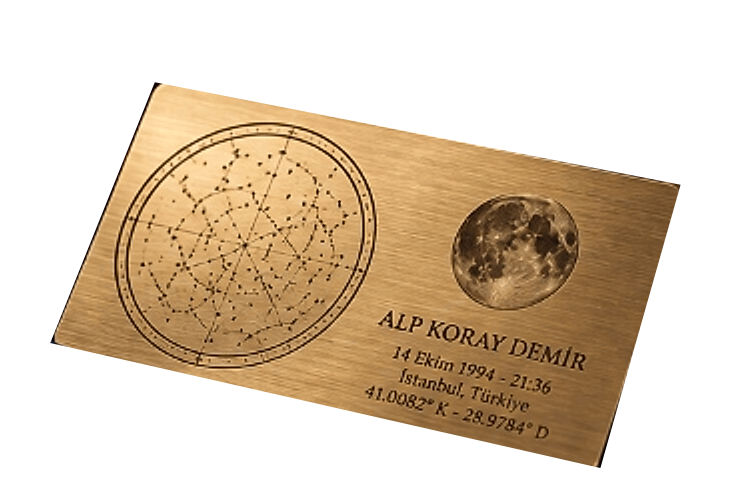
The real sky positions for your chosen date, exact time and place are computed and turned into a personal brass card. It contains no astrological interpretation.
Personal Brass Sky Card
We show the product dimensions and design features that are documented. Thickness, weight and surface details without maker-sample confirmation are not presented as settled specifications.
ISO ID-1 size (85.60 × 53.98 mm), laser-engraved on both faces.
85.60 × 53.98 mm; 3.18 mm corner radius. Thickness and weight have not been confirmed with a maker sample.
Name, date, exact time and place — every card is computed and produced for a single person.
The card design reserves a QR area and unique identity on the back. Physical phone scanning is awaiting sample verification.
QR placement has been technically reviewed; physical sample scanning and maker engraving/QC values are not yet documented.
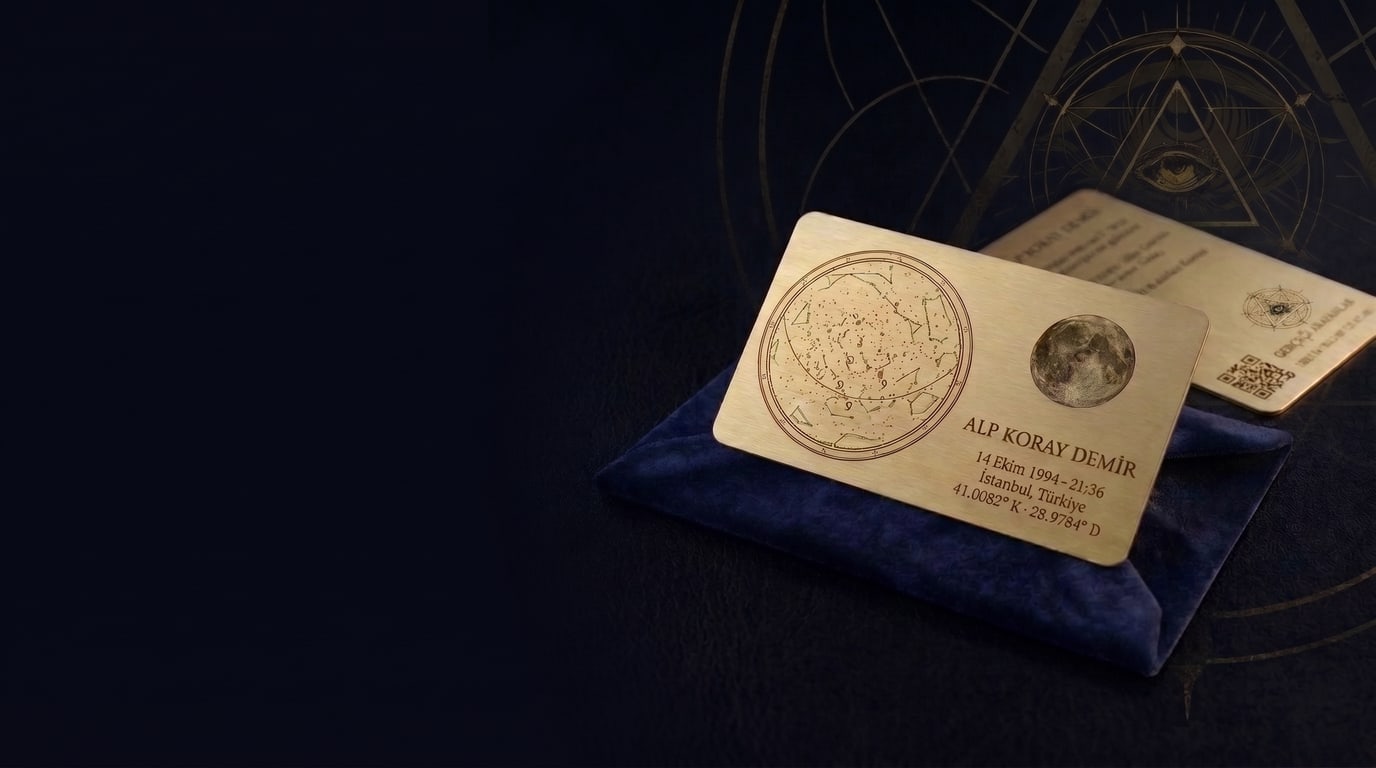
The card arrives ready to give, in its own envelope.
Computed, not interpreted.
A Sky Trace is built in six steps. Each step is deterministic: the same input always yields the same card.
Your birth place is resolved from GeoNames together with its coordinates and time zone; free text is not accepted.
Local time is converted to UTC with the historical time-zone and daylight-saving rules in force at that place on that date. In ambiguous hours (clocks moved forward or back) the system does not guess — it asks you.
The apparent positions of the Sun, Moon and planets at that instant are computed with the Astronomy Engine ephemeris; the Moon’s illuminated fraction is derived from the physical phase angle (Earth-centred / geocentric).
Bright stars come from the HYG v4.2 catalogue (card star-rendering threshold: apparent magnitude ≤ 4.0 — a catalogue/rendering cutoff, not an observational limit), are carried by their catalogue proper motions (J2000 → birth instant) and placed against your horizon with the same engine.
The sky is built against the geometric horizon of the birth place: bodies above it are drawn, bodies below it are not. No atmospheric refraction is applied.
Zenith at the centre, horizon on the ring; north up, east to the left (looking up at the sky). Every mark is a computed position — no decorative star, planet or line is added.
Daytime births still get a star field: the card shows the sky geometrically above the horizon at that instant, not naked-eye visibility. V1 draws no constellation lines — only computed star points. HYG proper motion is applied to star positions (μα·cosδ, μδ; linear from J2000 to the birth instant). The Moon disc is a clean phase geometry derived from the physical illuminated fraction and the waxing/waning direction (uniform hatch on the lit region, solid on the dark region); it claims no crater or mare map, libration or disc orientation. The dashed line in the dome is the ecliptic reference computed in the same projection; labels mark only the bodies above the horizon and a few of the brightest named stars, placed by a deterministic collision rule. The technical lines on the back (Julian date, apparent local sidereal time, Sun/Moon altitude-azimuth, geocentric Moon distance, planet distances) come from the same engine’s documented functions; the coordinates printed on the card are the very coordinates used in the calculation. Sources: Astronomy Engine 2.1.19 · HYG Database v4.2 (CC BY-SA 4.0, astronexus.com) · IANA time zone database (historical offsets to the second).
FROM COMPUTATION TO PHYSICAL OBJECT
The astronomical record moves into the design; both card faces are prepared, then verification and final inspection are completed.
Date, exact time and place become one sky record.
The computed star dome and personal details are placed on the card faces.
The personalized design receives a visual review before production.
The card body is prepared for engraving.
Both faces are laser-engraved according to the approved card design.
The card identity is matched with its verification record.
The card and its personal record are checked before packaging.
The card is placed in its navy velvet presentation envelope.

Test
Crown Chakra Mini Discovery
Crown chakra theme

Essential oil
Frankincense Essential Oil
Third Eye chakra theme · Crown chakra theme

Herb
Bilberry
Third Eye chakra theme

Incense
Hinoki Cypress Incense
Crown chakra theme
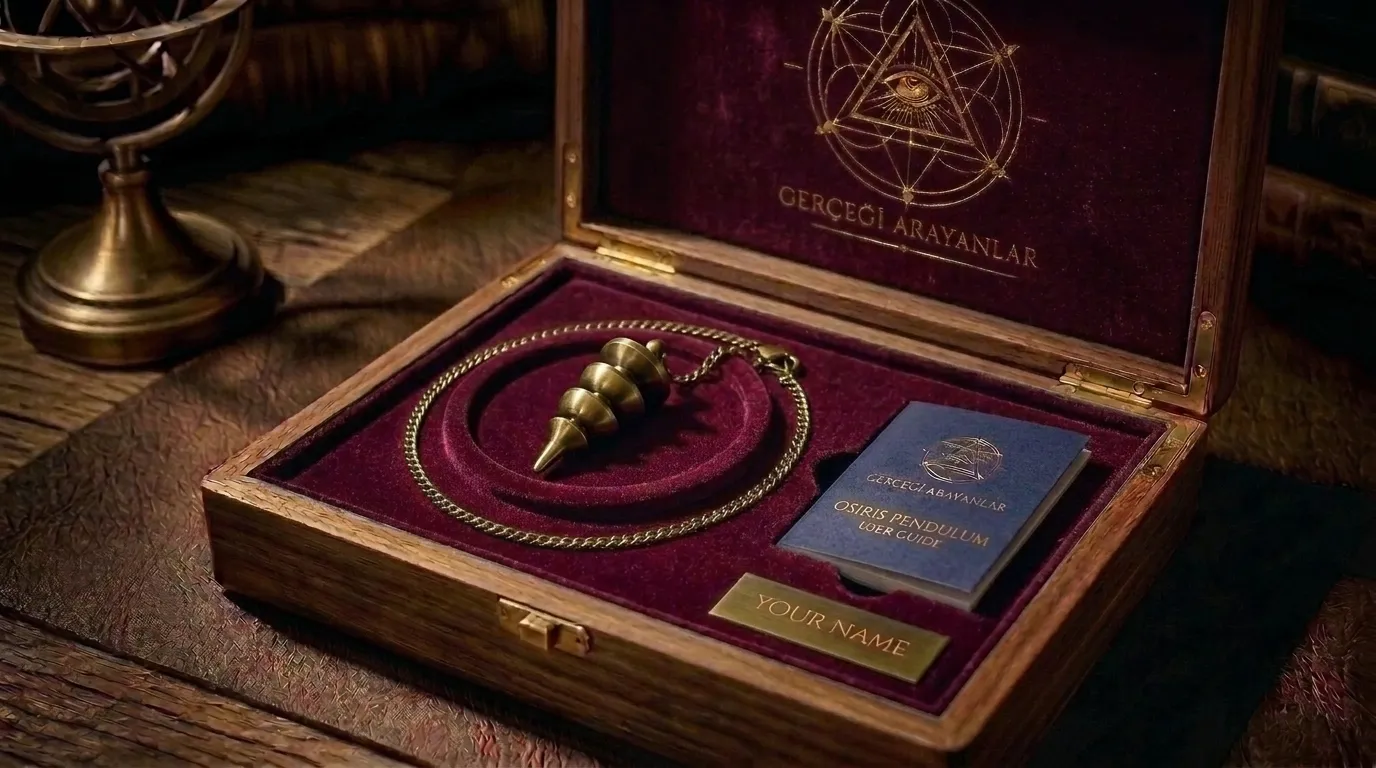
Pendulum
The Osiris Seal Solid Brass Pendulum
Third Eye chakra theme

Stone
Tanzanite
Third Eye chakra theme
Front: the sky seen from your birth place at your birth moment — the bodies above the horizon and the bright-star field — the Moon’s phase geometry at that instant; your name, the date, the exact time, the birth place and its coordinates. Back: a short record sentence for that moment, the Moon’s illuminated fraction and phase, the bodies above the horizon, a single notable sky event if one fell on that day, the verification QR and the card number. Identity details are not repeated across the two faces.
No. The sky turns 15° every hour; without the time the horizon cannot be placed. This product is never computed without an exact time — no default, approximate or noon time is used. The time is usually on the birth certificate, the hospital record or the civil registry extract.
Because Full Moon is an instant: the minute the Moon stands exactly opposite the Sun. The card records your moment, not that one. The illuminated fraction is computed from the physical phase angle (Earth-centred). If your birth is within 6 hours of the exact phase, the phase name is used; otherwise the Moon’s true state — waxing or waning, crescent or gibbous — and its illuminated percentage are written. When a principal phase is near, the distance to it is stated too: “17 h before Full Moon”.
The birth instant is converted to UTC with the historical time-zone rules in force on that date (including daylight-saving transitions). The apparent positions of the Sun, Moon and planets come from Astronomy Engine 2.1.19; stars from the HYG v4.2 catalogue at the card star-rendering threshold of apparent magnitude ≤ 4.0 (a rendering cutoff, not a naked-eye visibility limit). The horizon is geometric; no atmospheric refraction is applied. The engine’s core position results were independently compared against JPL Horizons.
Yes. The card shows the sky geometrically above the horizon at that instant; in a daytime sky the stars are still there, only invisible. It is a record of position, not a claim of visibility.
Because lines are a drawing convention, not a measurement; without an approved, licensed figure source they do not belong on the card. V1 carries only computed star points, the bodies and the cardinal marks. A licensed figure set may follow in a separate release.
Brushed brass in ISO ID-1 size (85.60 × 53.98 mm), laser-engraved on both faces. Delivered in a navy velvet envelope.
Production starts only after a confirmed order; every card is engraved alone, for one person. The order flow is not open yet; it will be announced on this page.