

Incense
Sunpati Incense
You've tasted the false promise of mass-market 'spiritual' smoke. Now stand at the true threshold: a single verified species, a specific geography, a humble breath that asks only to be known for what it is.
- Herb
- Charcoal Burn
- Air
- Third Eye
Traditional associations
Begin by reading the material's name, its scientific identity, its geographic origin, and the specific communities who have used it. Honor source. Burn only a small pinch on glowing embers. Stand at the threshold between the mundane and the sacred. This is not consumption; it is acknowledgment.
Specially sourced
Deep layers
About Sunpati Incense
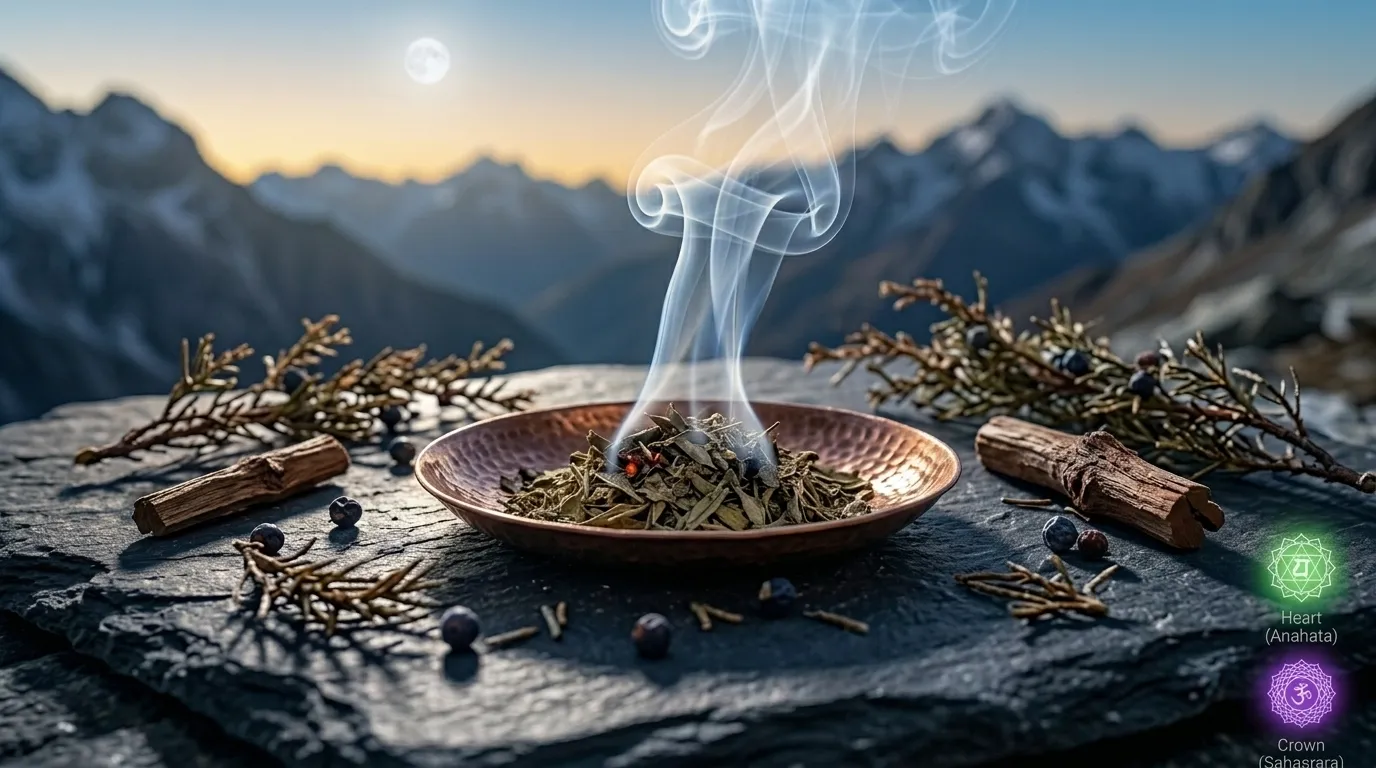
In the thin air of Himalayan peaks, where stone meets cloud and breath becomes offering, grows Rhododendron anthopogon—a dwarf shrub whose leaf and fine twig material has been gathered for centuries alongside juniper in sacred smoke rituals. Sunpati is not a name cast broadly across all rhododendrons; it is the precise, documented identity of this single species alone. When ethnobotanical records trace its presence in the smoke offerings of specific Himalayan communities, they speak not of universal truth but of rooted, regional practice—knowledge held by particular people in particular mountains.
To light Sunpati is to participate in a threshold practice: standing between the mundane descent of daily life and the ascending line of reverence. The resinous leaf and cool herbal notes rise without density, without the heavy promise of transformation. Instead, they whisper a simpler intention—respect for source, restraint in consumption, and the humble acknowledgment that not all smoke carries the weight of salvation. This is incense for those who understand that spiritual work sometimes means using less, knowing more, and honoring the specific land and people from which the material comes.
Yet this knowledge demands rigorous boundaries. Rhododendron species are not interchangeable; confusion invites harm. The material must be correctly identified, never ingested, and burned with strong ventilation in minute quantities. Your inner reverence must never compromise your physical safety, nor should the allure of ritual override the clarity of botanical truth.
Story
In the thin air where stone meets cloud, Rhododendron anthopogon grows as a dwarf shrub—its leaf and fine twig material gathered for centuries in sacred Himalayan smoke offerings. Sunpati is the precise name of this single species, not a broad category. To honor it is to honor specificity, source, and the particular knowledge of the mountains that shaped its use.
Traditional uses
Ethnobotanical documentation places Sunpati alongside juniper in smoke-offering practices among specific Himalayan communities. This knowledge is rooted in particular geography, climate, and spiritual tradition—not universal, but deeply particular.
Preparation / burning method
Use only a verified, correctly identified pinch of dry Rhododendron anthopogon leaf material. Place it on a fully gray, glowing incense charcoal or a controlled resin heater. Allow it to smolder without creating open flame or heavy indoor smoke. Limit use to minute quantities. Strong ventilation is essential.
Cleansing uses
Do not market this as a generic 'energy cleanser.' Sunpati belongs to the smoke-offering tradition of its source culture—a practice of reverence and threshold-marking rather than aggressive spiritual scrubbing. Use it in that specific context, with that specific intention.
Ritual context
Begin by reading the material's name, its scientific identity, its geographic origin, and the specific communities who have used it. Honor source. Burn only a small pinch on glowing embers. Stand at the threshold between the mundane and the sacred. This is not consumption; it is acknowledgment.
Aroma profile
Resinous leaf, cool herbal whisper, faint floral undertone, and the dry, mineral breath of high-mountain scrub—a scent that does not overwhelm but rather invites quiet attention.
Safety notes
Rhododendron species must never be substituted for one another; botanical confusion creates genuine harm. Use only correctly identified, incense-prepared Rhododendron anthopogon. Never ingest. Avoid all direct inhalation of smoke. Ventilate the space strongly. Burn only a tiny pinch. Never leave the ember unattended. This is non-negotiable.
Origin
The canonical scientific identity is Rhododendron anthopogon. Its documented use appears in ethnobotanical records of specific Himalayan communities, establishing both geographic and cultural context that must remain visible in any presentation.
Quick look
Properties
- Scientific name
- rhododendron anthopogon
Which chakra is it known for?
Form
- Herb
Which element is it associated with?
- Air
Which chakra is it associated with?
- Third Eye
- Crown
Burn method
- Charcoal Burn
Follow This Thread


If you stayed this long on the Sunpati Incense page, the matter may not be curiosity about incense alone.
The chosen incense is sent in a solid walnut box with brass inlay, sealed to your name. Which incense walks with you is decided not from a list, but from what you share.
No payment, no commitment. First you write what you want.