

Herb
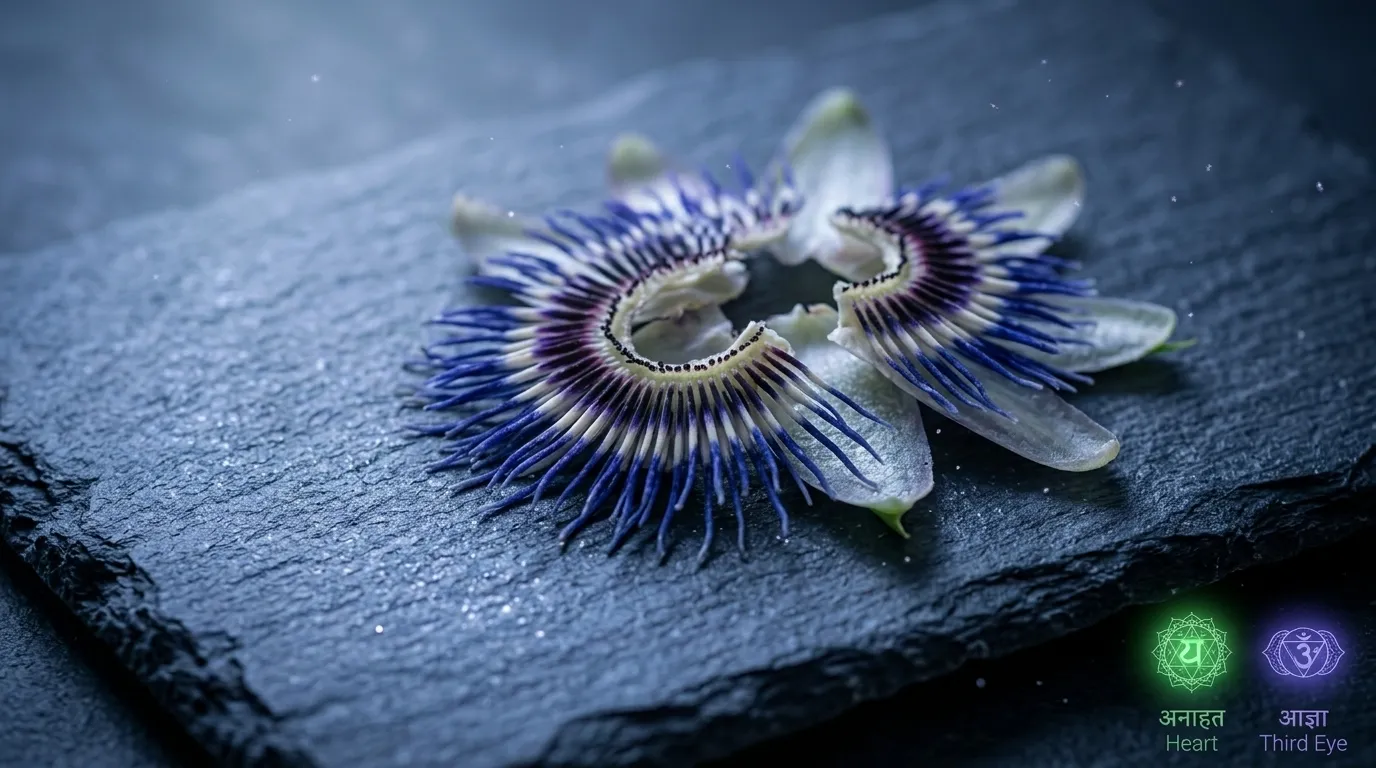
Passionflower
Is your mind a prisoner of unsolved riddles? Passionflower does not promise swift answers—it offers something far more precious: the sacred permission to stop fighting, to breathe beside the mystery, and to discover that acceptance itself is the first key to peace.
- Third Eye
- Crown
- Scientific name: passiflora incarnata
- Calm
Traditional associations
In ancient and traditional North American wisdom, Passiflora incarnata was honored as the flower of patient surrender—its intricate crown of filaments a living meditation on the art of staying with what cannot yet be solved. European herbalists later embraced this dried aerial material as a bridge between restless thought and the quietude of acceptance.
Specially sourced
Deep layers
About Passionflower
For those whose minds circle endlessly around unsolved riddles, Passiflora incarnata—the aerial flowering parts of this singular North American bloom—offers something rare: permission to stop wrestling and simply witness. Unlike other Passiflora species cultivated for their edible fruit, this particular expression carries a frequency of acceptance and patient release. The intricate corona of filaments crowning its center mirrors the complexity of the human heart, teaching that not every knot demands immediate loosening. Some truths ask only that we remain present beside them, breathing, until clarity arrives of its own accord. In this stillness, the restless mind discovers its first real rest.
Yet wisdom demands honest boundaries: this plant's historical and spiritual associations speak to intention and ritual, never replacing medical science or professional assessment. If you take sedating medications, consume alcohol, or are navigating pregnancy, nursing, childhood, or activities requiring full mental clarity, seek qualified guidance before use. The flower's teaching is genuine, but it works only when paired with self-knowledge and respect for your body's true needs.
Story
In ancient and traditional North American wisdom, Passiflora incarnata was honored as the flower of patient surrender—its intricate crown of filaments a living meditation on the art of staying with what cannot yet be solved. European herbalists later embraced this dried aerial material as a bridge between restless thought and the quietude of acceptance.
Historical uses
Passed into European herbal tradition from North American indigenous knowledge, dried Passiflora incarnata has been prepared as a contemplative infusion—not for swift resolution, but for the cultivation of patient presence beside unresolved tensions.
Cultural / spiritual uses
In Christian mysticism and modern contemplative practice, the flower's elaborate corona of filaments symbolizes the Crown of Thorns—a paradoxical reminder that suffering, when witnessed with presence and acceptance, becomes a gateway to grace. The ritual of sitting with Passionflower teaches that not all knots demand solving; some demand only that we learn to breathe beside them.
Aroma profile
A delicate whisper of dried grass and subtle florals, with the faint earthiness of meadow air—an aroma that invites quietude rather than excitement.
Preparation notes
Traditionally prepared as a slow infusion of dried aerial parts in warm water, allowing the subtle essences to unfold. This text offers no dosing recommendations, duration, or extract guidance. Source only authenticated, clean botanical material from trusted suppliers.
Season / harvest
The aerial parts—stems, leaves, and flowers—are gathered during the plant's peak flowering season, when the intricate crown of filaments reaches its fullest expression. Correct species verification is non-negotiable.
Safety notes
Critical caution: Do not combine with sedating medications, alcohol, or any substance causing drowsiness. Avoid use before activities requiring mental alertness or motor control. Pregnancy, nursing, childhood, and concurrent pharmaceutical use demand professional medical assessment before any preparation.
Origin
Authentic Passiflora incarnata is distinguished by its North American provenance and its aerial flowering parts—not to be confused with tropical Passiflora species cultivated for their edible fruit. The integrity of the botanical source is sacred.
Quick look
Scientific name: passiflora incarnata
Properties
- Scientific name
- passiflora incarnata
Which chakra is it known for?
Which chakra is it associated with?
- Third Eye
- Crown
Follow This Thread
If you stayed this long on the Passionflower page, the matter may not be curiosity about herbs alone.
The chosen herb is sent in a solid walnut box with brass inlay, sealed to your name. Which herb walks with you is decided not from a list, but from what you share.
No payment, no commitment. First you write what you want.